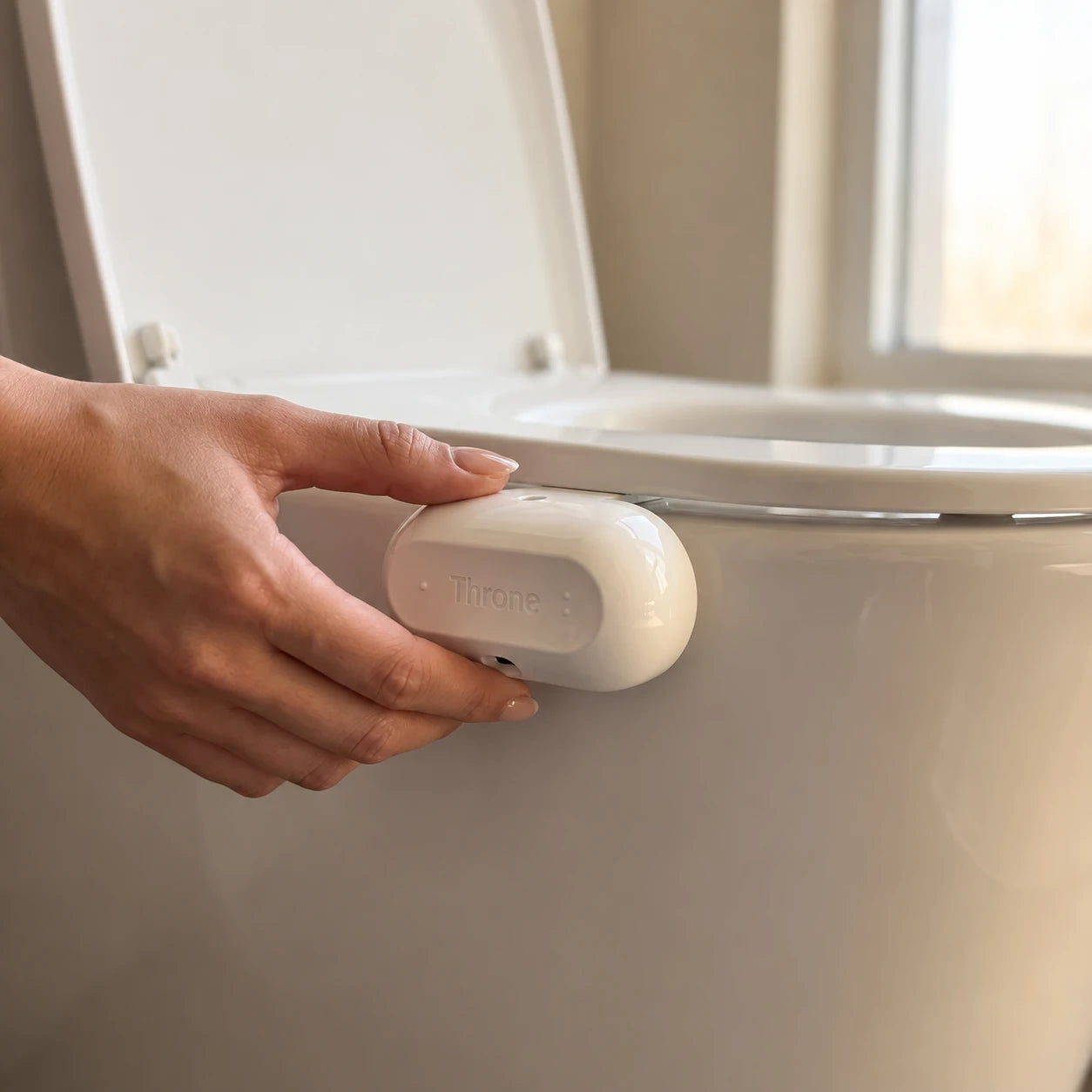
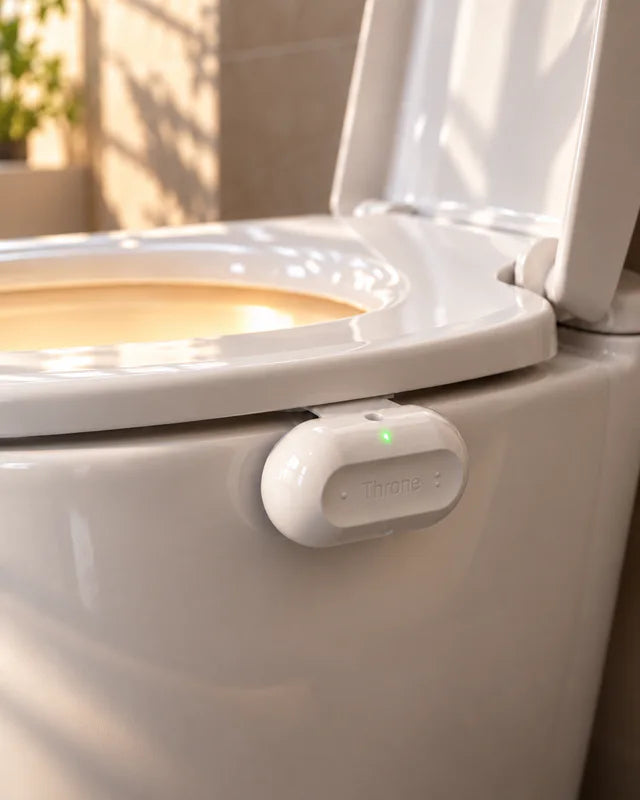
Throne clips onto your toilet and records every bowel movement for you: how often, what form, and what time. Between GI appointments, you’ll have a real record instead of a guess.
Your GI sees you every few months. Your gut changes every day.
You’ve counted trips on a notepad, in your notes app, maybe on a click counter, until you stopped.
So when your GI asks how you’ve been, what do you say?
Flares creep in. Weeks blur together. It’s hard to know whether this week is a flare, a stomach bug or just a bad week without a record of what your normal looks like.
Your days, in order
See your days, not just your scopes.
Throne records every visit on its own. Mark a change in your Journal, like a new medication, a steroid taper or a hospital stay, and compare the weeks before and after with numbers instead of memory.
Weeks 1–4
Know your normal.
In remission, this person averages about 2 BMs a day, and 80% are in the healthy range. That’s their baseline.
Weeks 5–8
See the change early.
Visits climb past 5 a day, and liquid stools go from almost none to 38%. They bring the trend to their GI instead of a guess.
Weeks 9–12
Watch the weeks after.
After a medication change, the count drifts back toward 2 a day. By the last week, 79% of stools are back in the healthy range.
In remission, this person averages about 2 BMs a day, and 80% are in the healthy range. That’s their baseline.
Weeks 5–8
See the change early.
Visits climb past 5 a day, and liquid stools go from almost none to 38%. They bring the trend to their GI instead of a guess.
Weeks 9–12
Watch the weeks after.
After a medication change, the count drifts back toward 2 a day. By the last week, 79% of stools are back in the healthy range.
3.4Stools a day, on average
Symptoms change
Started a new medication
Week 1Week 5Week 9Week 12
Liquid21(22.3%)
Loose23(24.5%)
Healthy47(50%)
Hard3(3.2%)
Weeks 1–4, your normal
Throne doesn’t diagnose flares or tell you whether a treatment is working. Share what you see with your GI, and don’t change your treatment without talking to them.
See your days, not just your scopes.. Trend view · 12 weeks: stools by type in each four-week period.
Period
Liquid
Loose
Healthy
Hard
Total
Per day
Weeks 1–4
0 (0.0%)
10 (20.0%)
40 (80.0%)
0 (0.0%)
50
1.8
Weeks 5–8 (Symptoms change)
54 (37.5%)
52 (36.1%)
32 (22.2%)
6 (4.2%)
144
5.1
Weeks 9–12 (Started a new medication)
21 (22.3%)
23 (24.5%)
47 (50.0%)
3 (3.2%)
94
3.4
Yes, it looks into your toilet. Here’s exactly what it sees.
Throne’s camera points straight down into the bowl. It sees what’s in the bowl and nothing else.
Your health information stays yours. Throne will never share your health information without your permission. You can export your data and request deletion at any time.
You already manage enough. This isn’t one more thing.
1
Clip it on.
Fits white toilets with rims up to 2.25 inches. No tools, no plumbing.
2
Go as usual.
No samples, no logging, no counting. Throne wakes up when you visit and records the session on its own.
Bristol type
How often
Time of day
Hydration
3
Look when you want to.
Your history is in the app when you need it. On good weeks, you can ignore it.
The numbers your GI asks about, recorded every time.
Every visit is placed on the Bristol Stool Scale, the same 1–7 chart your GI uses. Throne also counts how often you go and when, including overnight, and gives you a daily hydration score from urine concentration, which helps on high-output days. Throne’s AI is trained by practicing physicians.
Stool-form categories describe appearance. They are not a diagnosis.
What Throne records
Form, frequency, timing and hydration, for every visit, with no logging.
What it doesn’t do
Throne doesn’t measure inflammation or detect blood, and it doesn’t replace calprotectin, bloodwork or a scope. Add what you notice, like blood, mucus or urgency, to your Journal so it’s part of your record.
Stop answering “how have you been?” with “okay, I guess.”
Download a 90-day PDF summary or a CSV and bring it to your GI, or send it through your patient portal. It’s the history they ask for, with dates: how often, what form, overnight visits, and weeks of trends instead of the one bad day you remember.
Elle WoodsJul 1 – Sep 28, 2026exported Sep 28, 2026
Throne 90 Day Wellness Report
Daily observations across gut health, hydration, bathroom habits, and urinary function. Prepared for personal review or to share with a healthcare provider.
prepared for
Elle Woods
period covered
Jul 1 – Sep 28, 2026
exported
Sep 28, 2026
source
Throne
what’s inside
01Gut Healthdigestive pattern · Bristol scale · frequency · regularity
02Hydrationhydration score
03Bathroom Habitstotal session time · time to first evacuation
04Urinary Functionfrequency · nighttime
Elle WoodsJul 1 – Sep 28, 2026exported Sep 28, 2026
01
Gut Health
Throne looks at the consistency, frequency, and timing of your bowel movements to build a longitudinal picture of your digestive patterns. Everything below reflects the 90 days ending Sep 28, 2026.
Digestive patterndaily · last 90 days
Jul 1 – Jul 3048 total
Liquid1327%
Loose1225%
Healthy1633%
Hard715%
Jul 31 – Aug 2951 total
Liquid1733%
Loose1122%
Healthy1733%
Hard612%
Aug 30 – Sep 2839 total
Liquid410%
Loose410%
Healthy3077%
Hard13%
Throne sorts each recorded stool into four consistency categories that group the Bristol Stool Scale: Hard (Bristol 1–2), Healthy (Bristol 3–4), Loose (Bristol 5), and Liquid (Bristol 6–7). Tracking how the mix shifts across the 90-day window helps you see your personal baseline and the day-to-day variation around it.
Elle WoodsJul 1 – Sep 28, 2026exported Sep 28, 2026
01Gut Healthcontinued
Bristol stool scaledaily · last 90 days
Jul 1 – Jul 3048 total
Type 736%
Type 61021%
Type 51225%
Type 41531%
Type 312%
Type 2510%
Type 124%
Jul 31 – Aug 2951 total
Type 748%
Type 61325%
Type 51122%
Type 41325%
Type 348%
Type 2510%
Type 112%
Aug 30 – Sep 2839 total
Type 713%
Type 638%
Type 5410%
Type 42564%
Type 3513%
Type 213%
Type 100%
The Bristol Stool Scale describes stool consistency across seven types, from firm and separate (Type 1) to entirely liquid (Type 7). Throne classifies each recorded stool by type so you can follow how consistency varies across the window.
summary statisticsJul 1 – Jul 30Jul 31 – Aug 29Aug 30 – Sep 28Full 90 days
Bristol stool typetype 1–7
min
1
max
7
mean
4.5
mode
4
min
1
max
7
mean
4.6
mode
4
min
2
max
7
mean
4.2
mode
4
min
1
max
7
mean
4.4
mode
4
Elle WoodsJul 1 – Sep 28, 2026exported Sep 28, 2026
01Gut Healthcontinued
Stool frequencysessions per day · last 90 days
The number of bowel movements recorded each day. Typical frequency varies widely between individuals, so your own trend across the window is generally more informative than any single benchmark.
summary statisticsJul 1 – Jul 30Jul 31 – Aug 29Aug 30 – Sep 28Full 90 days
Stool frequencyper day
min
0
max
4
mean
1.6
mode
1
min
0
max
4
mean
1.7
mode
1
min
0
max
3
mean
1.3
mode
1
min
0
max
4
mean
1.5
mode
1
Elle WoodsJul 1 – Sep 28, 2026exported Sep 28, 2026
01Gut Healthcontinued
Regularitytime of day · three consecutive 30-day windows
Jul 1 – Jul 3048 recordedJul 31 – Aug 2951 recordedAug 30 – Sep 2839 recorded
Each clock shows the times of day when bowel movements were recorded, across a 30-day window. Every recorded movement is drawn as a translucent mark at its time of day, so the darkest spokes are the times where movements cluster. Reading the three clocks side by side shows how the timing of the routine has shifted month to month.
Elle WoodsJul 1 – Sep 28, 2026exported Sep 28, 2026
02
Hydration
Throne estimates how well-hydrated you appear to be from the color of your urine with every flush, giving you a continuous, longitudinal view without anything to wear or log.
Hydration scoredaily · last 90 days
Throne estimates hydration from urine color at each visit. The Hydration Score (0–100) increases with more dilute urine. The bold marks show the monthly average and its change from the previous month.
summary statisticsJul 1 – Jul 30Jul 31 – Aug 29Aug 30 – Sep 28Full 90 days
Hydration score%
min
41
max
68
mean
57
mode
52
min
45
max
72
mean
60
mode
54
min
52
max
75
mean
64
mode
57
min
41
max
75
mean
60
mode
52
Elle WoodsJul 1 – Sep 28, 2026exported Sep 28, 2026
03
Bathroom Habits
Throne measures how long you spend during each visit, giving you a longitudinal view of your habits over time. The shaded range reflects the natural variation across visits each day.
Total session timedaily average · last 90 days
The average time spent on the toilet each day across the 90-day window. The shaded band shows the range across individual visits within each day.
summary statisticsJul 1 – Jul 30Jul 31 – Aug 29Aug 30 – Sep 28Full 90 days
Total session timemin:sec
min
2:53
max
14:41
mean
7:16
mode
6:00
min
2:49
max
14:13
mean
6:06
mode
4:00
min
2:40
max
9:13
mean
4:49
mode
3:00
min
2:40
max
14:41
mean
6:01
mode
6:00
Elle WoodsJul 1 – Sep 28, 2026exported Sep 28, 2026
03Bathroom Habitscontinued
Time to first evacuationdaily average · last 90 days
The average time between sitting down and the first evacuation, by day. The shaded band shows the range across individual visits within each day.
summary statisticsJul 1 – Jul 30Jul 31 – Aug 29Aug 30 – Sep 28Full 90 days
Time to first evacuationmin:sec
min
0:08
max
4:39
mean
1:12
mode
0:30
min
0:16
max
3:40
mean
1:02
mode
0:30
min
0:11
max
3:28
mean
0:58
mode
1:00
min
0:08
max
4:39
mean
1:04
mode
0:30
Elle WoodsJul 1 – Sep 28, 2026exported Sep 28, 2026
04
Urinary Function
Throne measures the timing and frequency of each urination. The chart below summarizes these patterns over the last 90 days, framed around your own personal baseline.
Urination frequencytimes per day · overall and nighttime · last 90 days
All urinations (per day)Nighttime only (10:00 PM – 6:00 AM)
The total number of urinations recorded each day, shown with the nighttime subset recorded between 10:00 PM and 6:00 AM. Daily frequency varies with fluid intake, caffeine, activity, and timing of meals, so the trend across the window is generally more informative than any single day.
summary statisticsJul 1 – Jul 30Jul 31 – Aug 29Aug 30 – Sep 28Full 90 days
Urination frequencyper day
min
4
max
9
mean
6.5
mode
6
min
4
max
9
mean
6.7
mode
7
min
4
max
10
mean
7.5
mode
7
min
4
max
10
mean
6.9
mode
7
Nighttime urinationsper day
min
0
max
2
mean
0.5
mode
0
min
0
max
2
mean
0.2
mode
0
min
0
max
2
mean
0.4
mode
0
min
0
max
2
mean
0.4
mode
0
Page 1 of 9
PDF90-day summaryCSVFull history
A note from our co-founder
Built by the IBD community, for the IBD community.
I was diagnosed with severe pancolitis in 2016. Since then I’ve had multiple hospitalizations, dramatic weight and blood loss, a carousel of medications, and a fecal transplant for a recurrent C. diff infection. I’ve sat across from some of the best gastroenterologists in the country. I’ve also sat in a bathroom at 3 a.m. trying to decide whether what I was seeing meant I should call my doctor in the morning or drive to the ER right now.
When I’m in a flare, my GI sees a 20-minute slice of me every few weeks. The lab sees a snapshot. The colonoscopy sees a single morning. Everything else lives only in my head, and it fades fast.
I spent ten years as co-founder and CTO of WHOOP. The lesson was simple: when you measure something passively, so you collect the data without thinking about it, you change what’s possible. Throne does that for the bathroom. It gives you a continuous, objective record of your gut without the work of journaling every visit.
Throne isn’t a medical device, and it doesn’t replace your care team. It’s our attempt to close the gap between what your body knows and what you and your doctor can see.
John CapodilupoCo-founder & Chief Product Officer · Living with ulcerative colitis since 2016 · Patient advocate, Crohn’s & Colitis Foundation
McDonald Endowed Chair in IBD Clinical Research · Western University
What Throne is, what it isn’t, and when to call your doctor.
What it is.
A sensor that records the form, frequency and timing of every visit, and shows changes from your own baseline.
What it isn’t.
A medical device. It doesn’t diagnose Crohn’s, UC or a flare, measure inflammation, or tell you whether to change treatment.
When to call your doctor.
Heavy bleeding, fever, severe or worsening pain, signs of dehydration, or anything that feels different. Don’t wait for a trend.
Everything you need to know your normal.
Throne
Throne tracks automatically. It wakes up when you visit and scans the bowl, so there’s nothing to log, even on your worst days.
Hands-free
30 days per charge
Up to 6 members per device
Throne app
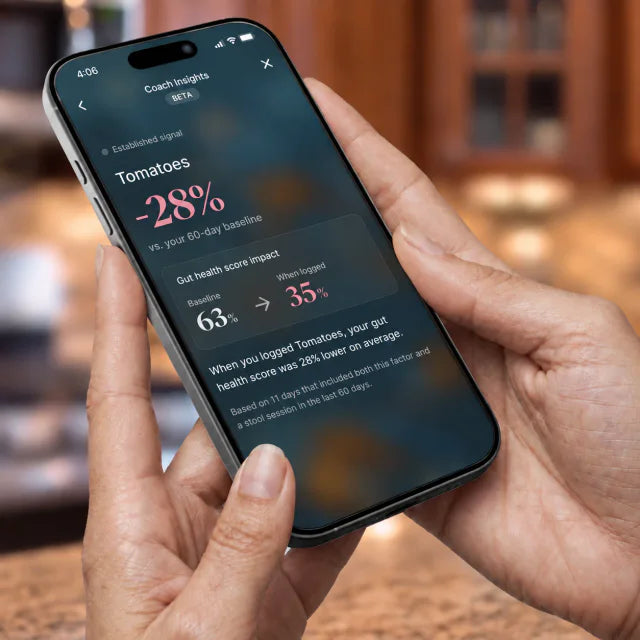
Your history, ready for your GI. Trends, Bristol breakdowns and a 90-day PDF you can share. Note meds, infusions and symptoms in your Journal so they sit alongside your data.
Bristol trends
90-day PDF
Journal
Throne
$399Membership: first 3 months free, then $6/month
No. Throne’s camera points directly into the bowl and sees nothing else. Your data is encrypted, and Throne will never share your health information without your permission.
Will it keep up during a flare, when I’m going 15 or 20 times a day?
Throne records every session automatically. There’s nothing to log, however often you go.
Does it detect blood?
No. Throne doesn’t flag blood. If you notice blood or mucus, add it to your Journal so it’s in your record and your GI report, and call your doctor if you’re bleeding heavily.
Can I share my data with my GI?
Yes. Download a 90-day PDF summary or a CSV from the app and bring it to your appointment or send it through your patient portal.
Will Throne tell me if I’m having a flare?
No. Throne shows how your patterns compare with your own baseline. Deciding what a change means is for you and your GI.
How do I keep it clean?
Use the same cleaning supplies you use on the rest of your bathroom. Throne is built for the bathroom, so regular household cleaners are fine.
What does membership include?
Unlimited tracking across multiple Throne devices, your Journal, and Gut Health Coach for $6/month per member. The first two members to pair with a device each get their first 3 months free. An active membership is required to use the Throne app.
Can I pay with HSA or FSA?
Yes. Pay with eligible HSA/FSA funds through Truemed at checkout and save up to 30%.
What if it doesn’t help?
Every Throne comes with a 30-day home trial. If it isn’t telling you anything useful, send it back.
Walk into your next GI appointment with real data.
Let Throne keep the record for a month, and see what your normal looks like.