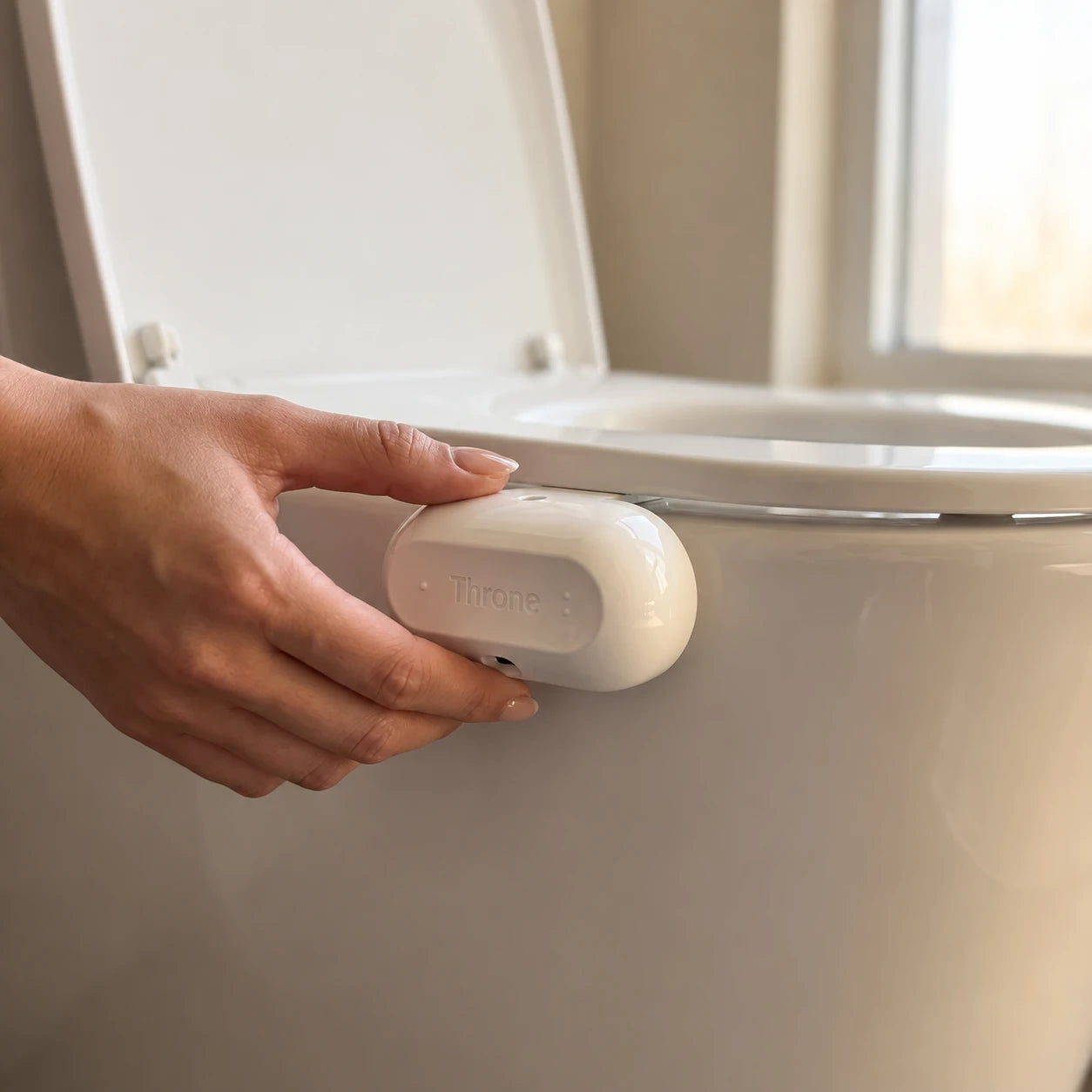
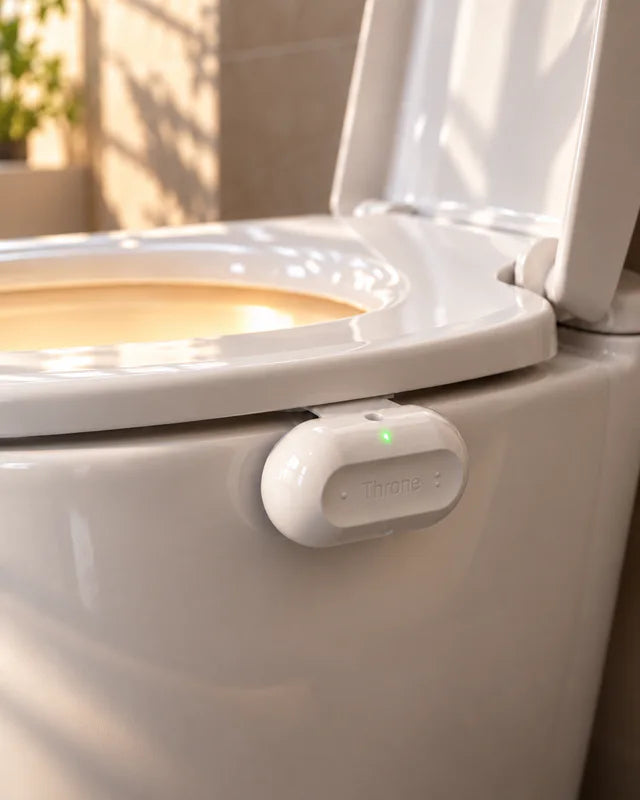
Throne mounts on your toilet, just under the seat, and logs every bowel movement for you: Bristol type, frequency and timing, plus a daily hydration score. Whatever you’re trying, from a new fiber to a new med, you’ll see whether it’s working.
Your tests came back normal. Your days don’t feel normal.
You’ve tried fiber, probiotics, peppermint oil and a new diet.
Which one actually helped?
Triggers show up hours or a day later, so nothing lines up. You’re not imagining it, and you’re not doing it wrong. You just don’t have the data.
Test one change at a time
Most people try five things. Find out which ones are worth paying for.
Note what you change in your Journal: a new fiber, a FODMAP reintroduction, a new med. Then compare your weekly and monthly trends before and after, with numbers instead of a feeling.
Weeks 1–4
See where you’re starting.
Throne logs every visit on its own. After a month you know your mix: here, 12% of stools liquid and 27% loose.
Week 5
Start a low FODMAP diet.
Over the next four weeks, liquid stools fall to 5%. Loose days still show up, so there’s more to try.
Week 9
Add psyllium husk.
Four weeks later, 86% of stools are in the healthy range, up from 58% at the start. Now you know which changes were worth keeping.
Throne knows it’s you, hands-free or with the push of a button.
A motion sensor wakes Throne as you walk up, and it recognizes the phone paired with your account over Bluetooth. No phone? Press your assigned button.
2
Go like you always do.
The downward-facing sensor tracks each visit automatically. Nothing to press, photograph or write down.
3
Get a report card after every flush.
See Bristol type, frequency, timing and hydration, with weekly and monthly trends. Keep noting meals and meds in your Journal if you like.
The details you’ve been trying to remember, recorded for you.
Every visit is placed on the Bristol Stool Scale, the same 1–7 chart your GI uses. Throne also counts how often you go and when, and gives you a daily hydration score from urine concentration. Throne’s AI is trained by practicing physicians.
Stool-form categories describe appearance. They are not a diagnosis.
What you’ll see, by IBS type
IBS-D. How many days were mostly type 6–7, whether visits cluster at certain times of day, and your hydration score after a rough day.
IBS-C. The real number of days between bowel movements, how often you land at type 1–2, and whether fiber and water move you toward 3–4.
IBS-M. How often you swing between hard and loose, and how long each phase lasts.
How to use it
Review the pattern with your doctor or dietitian when you’re testing a diet change, supplement or new med. Throne can’t tell you whether you have IBS; your doctor makes any diagnosis.
Walk into your next appointment with a record, not a guess.
Download your history as a CSV or an easy-to-read 90-day PDF summary for your GI, dietitian or pelvic floor therapist. It’s the history they ask for, with dates: how often, what form, and weeks of trends instead of one bad day.
Elle WoodsJul 1 – Sep 28, 2026exported Sep 28, 2026
Throne 90 Day Wellness Report
Daily observations across gut health, hydration, bathroom habits, and urinary function. Prepared for personal review or to share with a healthcare provider.
prepared for
Elle Woods
period covered
Jul 1 – Sep 28, 2026
exported
Sep 28, 2026
source
Throne
what’s inside
01Gut Healthdigestive pattern · Bristol scale · frequency · regularity
02Hydrationhydration score
03Bathroom Habitstotal session time · time to first evacuation
04Urinary Functionfrequency · nighttime
Elle WoodsJul 1 – Sep 28, 2026exported Sep 28, 2026
01
Gut Health
Throne looks at the consistency, frequency, and timing of your bowel movements to build a longitudinal picture of your digestive patterns. Everything below reflects the 90 days ending Sep 28, 2026.
Digestive patterndaily · last 90 days
Jul 1 – Jul 3048 total
Liquid1327%
Loose1225%
Healthy1633%
Hard715%
Jul 31 – Aug 2951 total
Liquid1733%
Loose1122%
Healthy1733%
Hard612%
Aug 30 – Sep 2839 total
Liquid410%
Loose410%
Healthy3077%
Hard13%
Throne sorts each recorded stool into four consistency categories that group the Bristol Stool Scale: Hard (Bristol 1–2), Healthy (Bristol 3–4), Loose (Bristol 5), and Liquid (Bristol 6–7). Tracking how the mix shifts across the 90-day window helps you see your personal baseline and the day-to-day variation around it.
Elle WoodsJul 1 – Sep 28, 2026exported Sep 28, 2026
01Gut Healthcontinued
Bristol stool scaledaily · last 90 days
Jul 1 – Jul 3048 total
Type 736%
Type 61021%
Type 51225%
Type 41531%
Type 312%
Type 2510%
Type 124%
Jul 31 – Aug 2951 total
Type 748%
Type 61325%
Type 51122%
Type 41325%
Type 348%
Type 2510%
Type 112%
Aug 30 – Sep 2839 total
Type 713%
Type 638%
Type 5410%
Type 42564%
Type 3513%
Type 213%
Type 100%
The Bristol Stool Scale describes stool consistency across seven types, from firm and separate (Type 1) to entirely liquid (Type 7). Throne classifies each recorded stool by type so you can follow how consistency varies across the window.
summary statisticsJul 1 – Jul 30Jul 31 – Aug 29Aug 30 – Sep 28Full 90 days
Bristol stool typetype 1–7
min
1
max
7
mean
4.5
mode
4
min
1
max
7
mean
4.6
mode
4
min
2
max
7
mean
4.2
mode
4
min
1
max
7
mean
4.4
mode
4
Elle WoodsJul 1 – Sep 28, 2026exported Sep 28, 2026
01Gut Healthcontinued
Stool frequencysessions per day · last 90 days
The number of bowel movements recorded each day. Typical frequency varies widely between individuals, so your own trend across the window is generally more informative than any single benchmark.
summary statisticsJul 1 – Jul 30Jul 31 – Aug 29Aug 30 – Sep 28Full 90 days
Stool frequencyper day
min
0
max
4
mean
1.6
mode
1
min
0
max
4
mean
1.7
mode
1
min
0
max
3
mean
1.3
mode
1
min
0
max
4
mean
1.5
mode
1
Elle WoodsJul 1 – Sep 28, 2026exported Sep 28, 2026
01Gut Healthcontinued
Regularitytime of day · three consecutive 30-day windows
Jul 1 – Jul 3048 recordedJul 31 – Aug 2951 recordedAug 30 – Sep 2839 recorded
Each clock shows the times of day when bowel movements were recorded, across a 30-day window. Every recorded movement is drawn as a translucent mark at its time of day, so the darkest spokes are the times where movements cluster. Reading the three clocks side by side shows how the timing of the routine has shifted month to month.
Elle WoodsJul 1 – Sep 28, 2026exported Sep 28, 2026
02
Hydration
Throne estimates how well-hydrated you appear to be from the color of your urine with every flush, giving you a continuous, longitudinal view without anything to wear or log.
Hydration scoredaily · last 90 days
Throne estimates hydration from urine color at each visit. The Hydration Score (0–100) increases with more dilute urine. The bold marks show the monthly average and its change from the previous month.
summary statisticsJul 1 – Jul 30Jul 31 – Aug 29Aug 30 – Sep 28Full 90 days
Hydration score%
min
41
max
68
mean
57
mode
52
min
45
max
72
mean
60
mode
54
min
52
max
75
mean
64
mode
57
min
41
max
75
mean
60
mode
52
Elle WoodsJul 1 – Sep 28, 2026exported Sep 28, 2026
03
Bathroom Habits
Throne measures how long you spend during each visit, giving you a longitudinal view of your habits over time. The shaded range reflects the natural variation across visits each day.
Total session timedaily average · last 90 days
The average time spent on the toilet each day across the 90-day window. The shaded band shows the range across individual visits within each day.
summary statisticsJul 1 – Jul 30Jul 31 – Aug 29Aug 30 – Sep 28Full 90 days
Total session timemin:sec
min
2:53
max
14:41
mean
7:16
mode
6:00
min
2:49
max
14:13
mean
6:06
mode
4:00
min
2:40
max
9:13
mean
4:49
mode
3:00
min
2:40
max
14:41
mean
6:01
mode
6:00
Elle WoodsJul 1 – Sep 28, 2026exported Sep 28, 2026
03Bathroom Habitscontinued
Time to first evacuationdaily average · last 90 days
The average time between sitting down and the first evacuation, by day. The shaded band shows the range across individual visits within each day.
summary statisticsJul 1 – Jul 30Jul 31 – Aug 29Aug 30 – Sep 28Full 90 days
Time to first evacuationmin:sec
min
0:08
max
4:39
mean
1:12
mode
0:30
min
0:16
max
3:40
mean
1:02
mode
0:30
min
0:11
max
3:28
mean
0:58
mode
1:00
min
0:08
max
4:39
mean
1:04
mode
0:30
Elle WoodsJul 1 – Sep 28, 2026exported Sep 28, 2026
04
Urinary Function
Throne measures the timing and frequency of each urination. The chart below summarizes these patterns over the last 90 days, framed around your own personal baseline.
Urination frequencytimes per day · overall and nighttime · last 90 days
All urinations (per day)Nighttime only (10:00 PM – 6:00 AM)
The total number of urinations recorded each day, shown with the nighttime subset recorded between 10:00 PM and 6:00 AM. Daily frequency varies with fluid intake, caffeine, activity, and timing of meals, so the trend across the window is generally more informative than any single day.
summary statisticsJul 1 – Jul 30Jul 31 – Aug 29Aug 30 – Sep 28Full 90 days
Urination frequencyper day
min
4
max
9
mean
6.5
mode
6
min
4
max
9
mean
6.7
mode
7
min
4
max
10
mean
7.5
mode
7
min
4
max
10
mean
6.9
mode
7
Nighttime urinationsper day
min
0
max
2
mean
0.5
mode
0
min
0
max
2
mean
0.2
mode
0
min
0
max
2
mean
0.4
mode
0
min
0
max
2
mean
0.4
mode
0
Page 1 of 9
PDF90-day summaryCSVFull history
The camera faces down. Always.
Throne’s camera points directly into the bowl. It sees what’s in the bowl and nothing else.
Guests stay private. Without a recognized phone or a button press, Throne won’t record.
Your health information stays yours. Throne will never share your health information without your permission. You can export your data and request deletion at any time.
What Throne is, and what it isn’t.
What Throne is.
A daily record of your bowel habits and hydration, a way to see trends and test changes, and something useful to bring to your care team.
What Throne isn’t.
A diagnosis or a test for IBS. It doesn’t replace your doctor, a colonoscopy or lab work, and it isn’t a cure. Nobody honest is selling one.
When to see a doctor.
See a doctor promptly for blood in your stool, unexplained weight loss, symptoms that wake you at night, new symptoms after 50, or a family history of colon cancer or IBD. Throne can’t rule these out.
Everything you need to run the experiment.
Throne
Throne tracks automatically. It wakes up when you visit and scans the bowl, so there’s nothing to log.
Hands-free
30 days per charge
Up to 6 members per device
Throne app
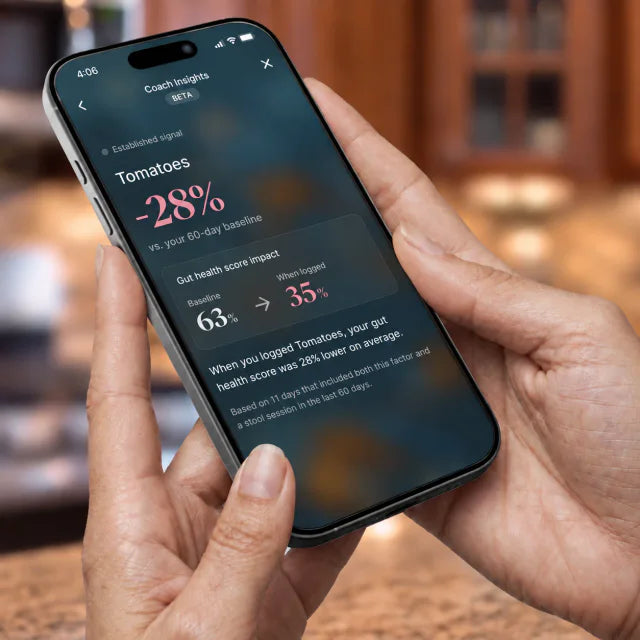
Your history and your notes, side by side. Note meals, meds and supplements in your Journal. Gut Health Coach connects them with your digestive history, and weekly and monthly trends show what changed.
Journal
Gut Health Coach
Weekly and monthly trends
CSV and 90-day PDF export
Throne
$399+ $6/month per member, first 3 months included
No. Throne’s camera points directly into the bowl and sees nothing else. Your data is encrypted, and Throne will never share your health information without your permission.
Will it tell me if I have IBS?
No. Throne records patterns you can review with your doctor, who makes any diagnosis.
Will Throne fit my toilet?
Throne is designed for most standard residential white toilets with a rim thickness up to 2.25 inches.
What about when I’m not home?
Log a bathroom visit in the app to keep your history together. You can add a photo, too.
Will watching my data make me more anxious?
You don’t need to check it every day. You can look at weekly trends instead, and bring your 90-day summary to appointments.
What does membership include?
Unlimited tracking across multiple Throne devices, your Journal, and Gut Health Coach for $6/month per member. The first two members to pair with a device each get their first 3 months free. An active membership is required to use the Throne app.
Can I pay with HSA or FSA?
Yes. Pay with eligible HSA/FSA funds through Truemed at checkout and save up to 30%.
What if it doesn’t help?
Every Throne comes with a 30-day home trial. If it isn’t telling you anything useful, send it back.
Trust your gut.
Let the diary keep itself for a month, and see what your normal looks like.
Throne is a general wellness product, not intended to diagnose, treat, cure, or prevent any disease. It does not replace medical advice. If you have symptoms that worry you, talk to a clinician.